Years
2013-2022
Institution
Ford’s Theatre Society
Ford’s Theatre visitors often didn’t realize that the site’s interior had been rebuilt in 1968, much less the debates over the decades over what to do with a site of tragedy.
During my nearly 9 years at Ford’s Theatre, I collaborated with colleagues to augment research on the site’s history and repurpose that content into programs and resources for different audiences, including blog posts, online exhibitions on Google Arts & Culture, website content, social media content, a distance learning program, exhibition panels, and two book chapters.
What I Did
Augmented & organized research
Building on photos and newspapers that an intern and board member had collected for a book, I created a shared Zotero collection and an internal image organization system.
As I encountered more references about Ford’s Theatre history, I added it to the Zotero collection, eventually building a large database.
Managed creation of online exhibitions
Supervised a graduate student intern who created Google Arts & Culture online exhibitions on the history of Ford’s Theatre and the Petersen House. I worked with her to select the content, use the platform, organize the content and story, and edit the writing.
Over the years, as we learned more, I edited the online exhibitions to reflect new research.
Created a distance learning program
During the COVID-19 pandemic, my colleague and I created a distance learning program about Ford’s Theatre history after the Lincoln assassination.
From the research we had on hand, we created a 45-minute narrated chronology, first in Prezi Video and later in mmhmm.
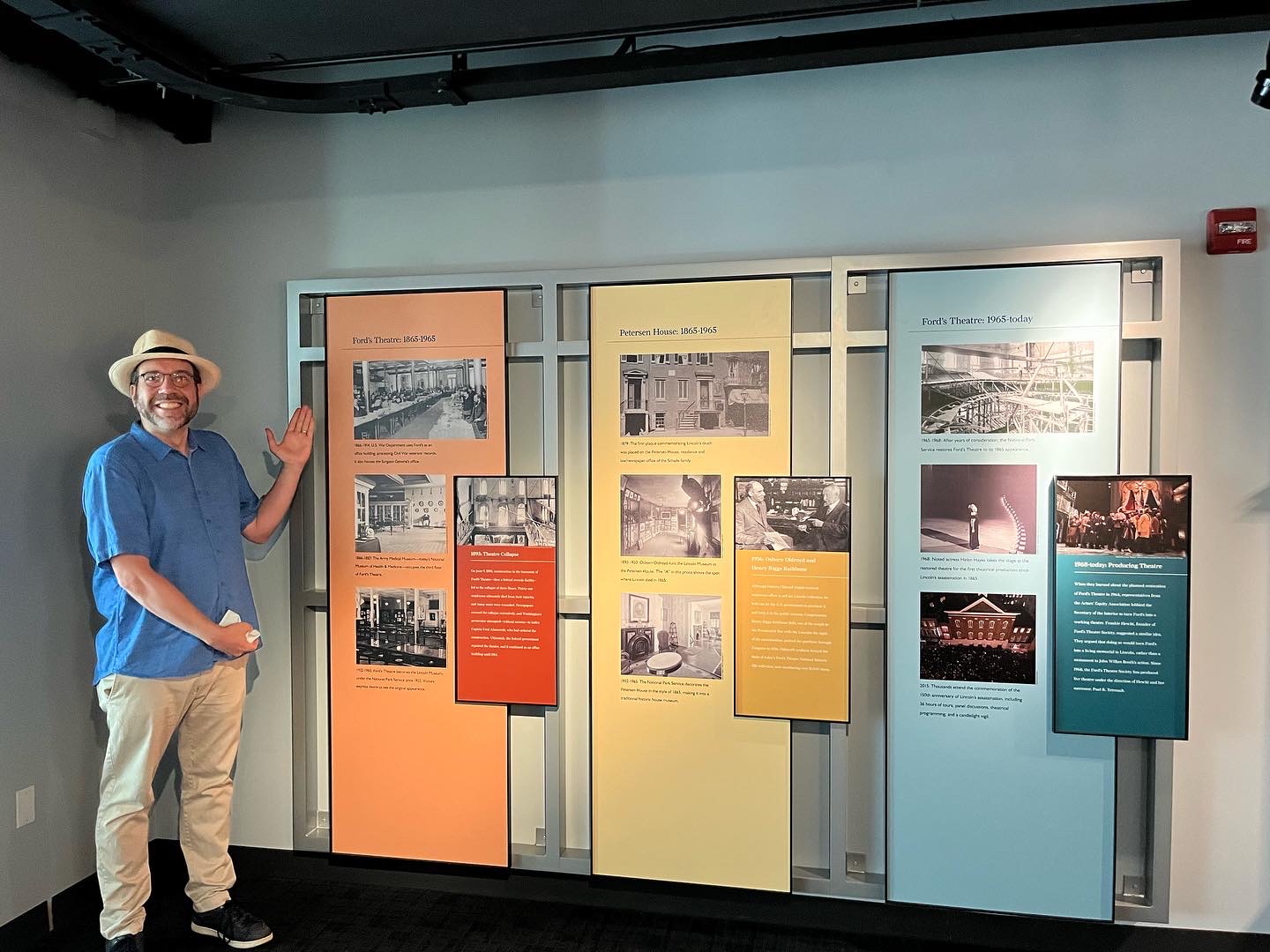
Created new exhibition panels
To address the lack of interpretation about the site’s history, I co-wrote a successful NEH grant in 2016 to plan an exhibition on that subject. That grant eventually was subsumed into overall site interpretation planning.
After visitor research showed few visitors stopped at a video wall, I suggested replacing it with a timeline of key moments in the site’s history.
Used templates for other graphic panels in the same gallery to design and produce new large graphic panels in InDesign.
Hired a fabricator and began the planning for installation of the panels, which finished after I had left Ford’s Theatre for a new job at the Folger Shakespeare Library.
Wrote book chapters
Colleagues and I, along with a University of Connecticut professor , co-wrote a chapter on Ford’s Theatre for an edited volume, Affective Architectures, published in 2020.
Researcher Sara Levine Bhatia and I augmented previous research with our own to produce a chapter on the Lincoln Museum in the Petersen House for an edited volume, U.S. Museum Histories and the Politics of Interpretation: Never Neutral, published in 2024.