Years
2013-2022
Institution
Ford’s Theatre Society
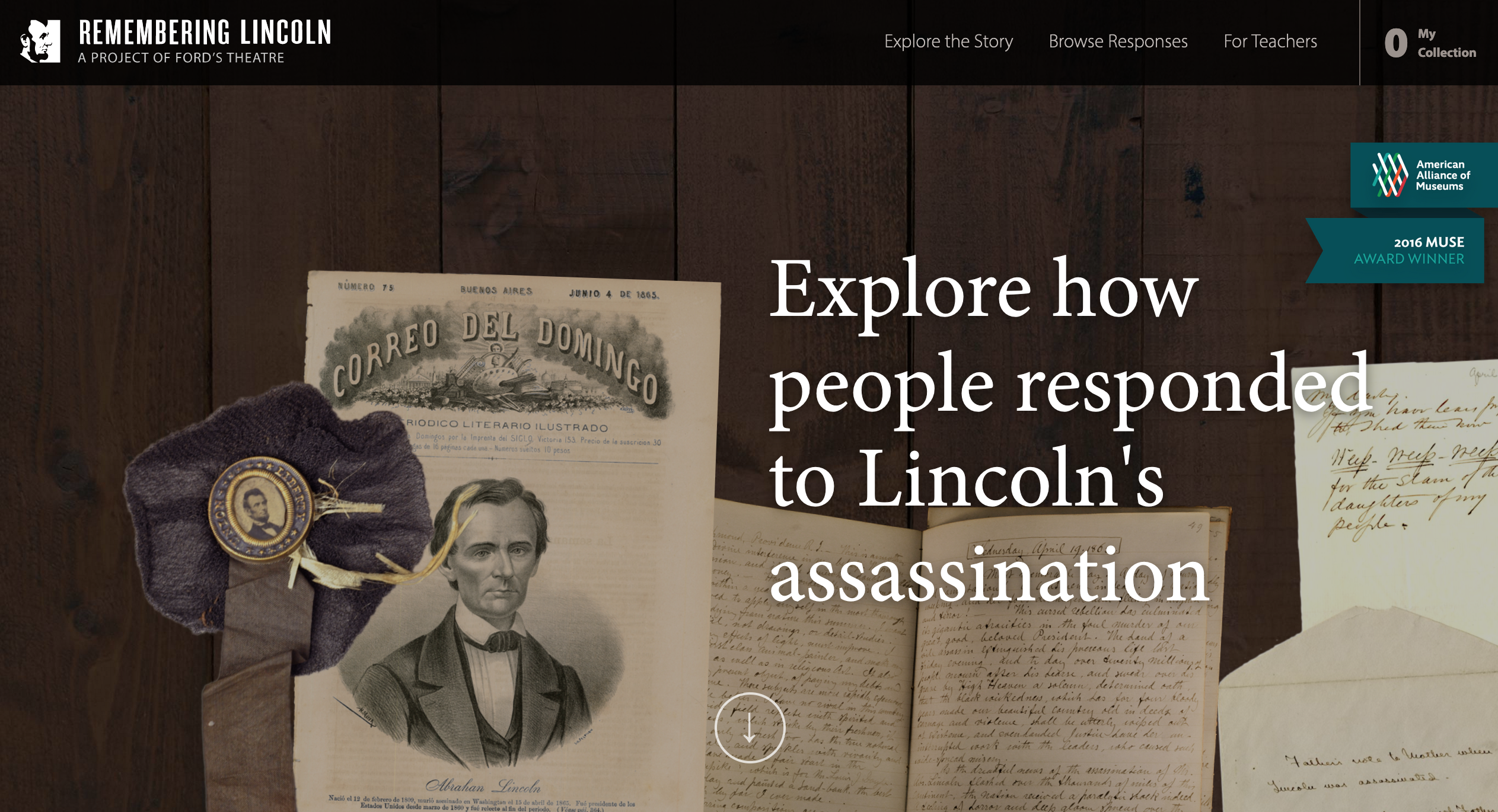
In 2013, Ford’s Theatre Society hired me as project manager for an IMLS-funded digital repository of responses to the Lincoln assassination, eventually called Remembering Lincoln. The repository’s goal was to expand the story of the Lincoln assassination beyond the Washington area and beyond the usual true crime story.
After the site’s launch in early 2015—in time for the 150th anniversary of Lincoln’s assassination—I led efforts to augment the collection and repurpose the content to engage broad audiences in different ways.
What I Did
Managed Partners & Advisors
Arranged a meeting of partners and advisors on the project to define the project’s goal and target audiences, in collaboration with my supervisor, a Digital Strategist, and an Evaluator.
Recruited new partners and contributors to the website. Ultimately, more than 40 organizations contributed materials.
Recruited Teacher Representatives to advise on the site’s functionality and content.
Managed Evaluation & Specifications
With my supervisor and the Evaluator, I coordinated a series of focus groups and surveys to understand our targeted audience groups. The Digital Strategist used the results to create a Product Definition Document defining the scope of the website.
After the site’s launch, I coordinated another set of focus groups and surveys that the Evaluator led to learn from teachers and enthusiasts. From those recommendations, I made changes to the website.
Managed Building the Collection
In collaboration with partners, I created metadata standards for items to come into the collection.
Worked with partner organizations to set up an Omeka.net website to ingest images and metadata from partner organizations and other contributors.
Worked with HistoryPin to set up a site to begin soliciting materials from members of the public.
Supervised interns who researched newspaper archives and added materials to the website.
Managed Website Development
Led a Request for Proposals process to hire a web developer.
Served as point-of-contact with the web developer to create the final site.
Ford’s Theatre launched the website a month before the 150th anniversary commemoration of the Lincoln assassination, allowing these stories to be a part of the anniversary.
Created Content for Website
In collaboration with an intern, I created a set of thematic tags for individual items, and tagged them to allow for in-depth exploration.
Wrote copy for the introduction and interpretive pages of the website.
Used TimelineJS to build a timeline incorporating selected responses to the Lincoln assassination into the larger story of the event.
Publicized the Project Amongst Professional Colleagues
Presented about the project at the American Association for State and Local History conference, for the Digital Cultural Heritage DC meetup, the National Council for Social Studies conference, and for the staff of IMLS.
Collaboratively Augmented & Described the Collection
After other organizations (like Minnesota Historical Society and Smithsonian Learning Lab) found that teachers, in particular, desired more robust description than was typical for archival collections, I worked with interns to update and augment item descriptions.
Worked with a high school and a college class to add items from their regions to the collection.
Worked with K-12 and college classes who transcribed items in the collection.
Supervised a teacher-in-residence who suggested and built lessons and methods for K-12 classes to contribute transcriptions and items.
Created Online Exhibition
As part of my work on history content for the Ford’s Theatre main website, I developed an “online exhibition” of responses to Lincoln’s assassination as a page on the main site.
Created Educational Programs & Resources
When the COVID-19 pandemic hit, I developed an interactive distance learning program about responses to Lincoln’s assassination. Structured as a tour of the United States in the wake of that event, I selected a set of geographically, ethnically, and politically diverse items that gave insight into divisions within the United States as the Civil War ended.
I created a self-directed lesson based on this program, with versions in Sutori and Google Forms, and an accompanying teacher guide.